

*Updated as of October 10, 2026*
Dan and I spent New Year’s Eve 2025 in Seville, Spain. We absolutely LOVED Seville, especially at New Year’s, and I will be writing more about our wonderful trip. While there, of course we had to take a Seville food tour, and we opted for one of our favorite food tour companies, Eating Europe. We took the Eating Seville: Tapas, Drinks & Local Flavors Tour on our first full morning, which took us through Santa Cruz, City Hall, El Salvador, and Alfalfa quarters, stopping in four tapas bars and an ice cream shop. This post details our food tour, which is absolutely worth it if you want a fast, guided crash course in Seville tapas. This post is not sponsored.

Seville on December 29, 2025.
Our tour began at 11:00 AM (although as of October 2026, that time is no longer offered; tours now leave at 12:00 PM and 6:00 PM and last about three hours) in the Santa Cruz neighborhood. We learned a bit about the neighborhood, which is historically the Old Jewish Quarter, before landing at our first stop. For those in Seville, Santa Cruz is a beautiful neighborhood filled with loads of history and adorable streets. Very European.

Walking through Santa Cruz, Seville.
Stop 1: Beer and Jamón at an Old Tapas Bar in Santa Cruz
The first stop of our tour was at Bar Las Teresas. Bar Las Teresas has been has been open for more than 150 years(!), since 1870. The bar itself is a tiny space with a few outdoor tables. Our group piled into the bar in the back room. There were about 10 of us, and we took up nearly all the indoor space. There were a few local couples eating outdoors when we visited, which was really adorable. The indoor space, in addition to being tiny, is OLD SCHOOL. Lots of old pictures adorning the walls, and numerous jamón hanging from the ceiling. Very atmospheric.
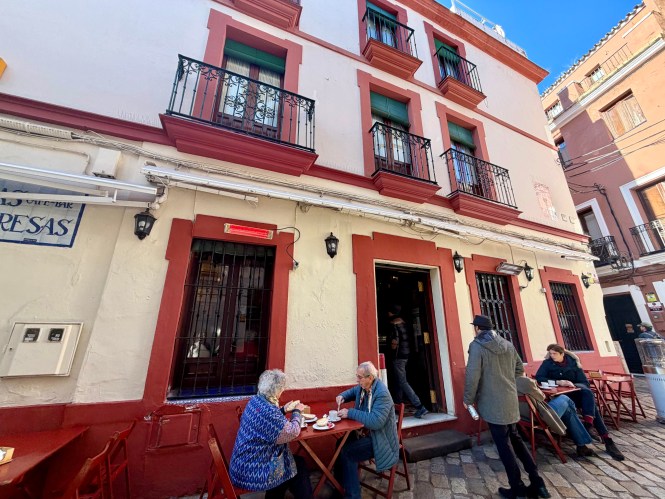
Cafe Bar Las Teresas. This couple is going to be me and Dan, except in Italy.

The packed interior of Las Teresas.

A fresh jamón. We would be sampling this exact one.
At Las Teresas, we began with a cold glass of local Seville beer, Cruzcampo. This was a bit rough to go down at 11:00 AM, LOL, but it was tasty. It was served in a old-school glass bearing the Cruzcampo name. I very much enjoyed the glass. The beer itself is a Spanish Pilsner, and the brand has been around since 1904. Heineken has since bought out the company.

A old-school glass of Cruzcampo beer.
We paired the Cruzcampo with the most delicious Jamón Ibérico de Bellota, which is Spain’s famous acorn-fed Iberian ham. And yes, this is the ham pictured above. We tried super slim slices of the Jamón Ibérico, and it was delicious. You cannot go to Seville without trying this dish.

Jamón Ibérico de Bellota.
In addition to the Jamón Ibérico, we also sampled a traditional plate of Papas Papas Aliñás. This dish a room-temperature potato salad dressed with olive oil, sherry vinegar, spring onion and parsley, and topped with a piece of cooked tuna. I LOVED the potato salad, but I did not love the tuna topping, LOL. I think it was just too much early in the day. That being said, it is a popular dish in Seville, and certainly worth a try. The tuna also did not overtake the dish, so it was easy to simply set it aside and enjoy the warm potato salad.

Papas Aliñás at Las Teresas.
Stop 2: Frizzante Wine and Charcuterie on Plaza del Salvador
We departed Las Teresas after the potato salad and walked 10 minutes through the heart of Seville to Plaza del Salvador. Plaza del Salvador is a lively public square located in the old part of Seville. It is very crowded this time of year (as everyone is off for Christmas), but also beautifully decorated. The main sight on the square is Iglesia Colegial del Divino Salvador, which you can visit, but it’s also a popular place to hang out, including into the late evening.

En route through Seville to our next tapas bar. I loved the oranges all over Seville in December.

The Iglesia Colegial del Divino Salvador in Plaza del Salvador.
Our tapas bar in Plaza del Salvador was La Antigua Bodeguita del Salvador. Despite it being late December, we sat outside on its terrace. This particular restaurant is a Seville institution, having been open since 1986. It is also one of the few old Seville tapas bars that accepts online reservations, making it an easy one for tourists to experience without navigating a wait.

The terrace at La Antigua Bodeguita del Salvador.
At La Antigua Bodeguita del Salvador, we began with a light white wine called Barbadillo Vi Cool Moscato Frizzante. This wine is certainly a “day wine,” having only 6.5% alcohol, it is considered semi-sparkling and made from Moscatel grapes from Andalucía.

The Frizzante wine against the pretty table top on La Antigua Bodeguita’s terrace.

The Barbadillo Vi Cool Moscato Frizzante.
We paired the Barbadillo Vi Cool Moscato Frizzante with yet another tuna dish, this one called Tuna Mojama. Tuna Mojama is a traditional Spanish tapas of salted, air dried tuna loin, sometimes called the “jamón of the sea” due to its popularity and color. It was very, very pretty, but it was not my favorite dish of the tour (actually, my least). The tuna was quite fishy, even when drizzled with lots of olive oil. And, very fun fact, the olive oil here was served in really cute individual packets!

Tuna Mojama.

The adorable little olive oil packets.
We also sampled an aged Manchego, which I much preferred to the tuna. The Manchego was also good with the olive oil.

Aged Manchego.
Stop 3: Traditional Tapas Near Las Setas
We left the sun-filled Plaza del Salvador and walked seven minutes to a more modern-style tapas bar located very close to Las Setas, Seville’s famous modern wood structure.

Las Setas.
The tapas bar is Mamá Carmen Sevilla. With indoor and outdoor seating in an almost “mall style” area, Mamá Carmen felt more modern than the other tapas restaurants we visited. That being said, its team has more than 30 years experience and serves traditional Seville dishes.

Mamá Carmen. You can see why I call it modern.
We began our tapas with our choice of beverage. Dan and I both selected for the Spanish red, or rioja, wine, which was a 2022 Crianza from Marqués de Vitoria. This wine was dry and medium-bodied, made from Tempranillo grapes from the Rioja Alavesa sub-region in Spain.

Spanish Rioja.
With our wine, every guest on the tour got to select a dish from the daily tapas menu. The menu here was very interesting as, unlike the other places where we had enjoyed what I consider to be more “appetizer” style dishes, this menu consisted of what seemed like more “meal” type dishes to me, just served in a smaller portion. Our guide suggested anything with the local “Brandy sauce,” and we took her up on that offer. And, for those unfamiliar, Brandy sauce is a sauce local to Seville that is made from Spanish brandy, garlic, stock, lemon juice, olive oil (some add cream), and it is delicious. A must try in Seville; it is easy to find.
Of the Brandy sauce dishes, we split two. The first was the very traditional and beloved Solomillo al Whisky (pork tenderloin). This dish consists of pork tenderloin medallions served in the Brandy sauce, topped with Ibérico ham shavings, and paired with frites. This dish was absolutely delicious, particularly the Brandy sauce. This was probably my favorite dish on the entire tour.

Solomillo al Whisky.
Our second Brandy sauce dish was another common one, a Tortilla de Patatas, or Spanish Potato Omelette in English. Unlike Mexican tortillas that I am used to in the US, or egg omelettes in the US, a tortilla or omelette in Seville is a dish that resembles a quiche or pie, which is made from egg and potatoes. The dish is savory and hearty. It tastes nothing like the tortillas or omelettes I know. This one was topped with the Brandy sauce and a single tomato. This dish was also very tasty, but I thought the pork was simply way better. Moral of the story, try both in Seville.

Tortilla de Patatas.
Stop 4: Flaming Sausage at a Very Old Tapas Bar
Our next stop took us back to a 100-year-old establishment only a 5 minute walk from Las Setas, Bodega La Aurora. Bodega La Aurora is a tapas bar in Seville’s Alfalfa neighborhood. It is tiny, and feels very much old school. I loved the vibe, including the green walls, the vintage Fernet-Branca advertisements, and the old wood tables. I felt very local coming here, although I think it is on the tourist circuit. Bodega La Aurora has been open since 1913, and its best known for its DIY flaming sausages.

Bodega La Aurora.

The bar at Bodega La Aurora. The price of the wine is right.

Vintage Fernet-Branca sign!
We began our Bodega La Aurora experience with the most beautiful Tinto de Verano. This is a a Spanish summer wine cocktail you can find all over Seville made with equal parts inexpensive red wine and lemon soda. It is a delicious drink that you can find all over Seville, usually at a very reasonable price. I was told that in Seville, instead of Sangria, locals drink Tinto de Verano. This Tinto de Verano was served in a cool glass with a slice of lemon and a large chunk of ice. It was delicious.

Tinto de Verano.

The Tinto de Verano.
Our main, and most exciting, dish here was, of course, the flaming sausage, actually called Choricito al Infierno. The sausage arrives raw and you cook it yourself over a flaming clay dish. This was kind of crazy, as the flames got pretty tall towards the end, and it took about 5 minutes to cook. When cooked, however, the sausage was absolutely delicious. I would return just for this bite.

Dan cooking the Choricito al Infierno.

The Choricito al Infierno.
We paired the sausage with Espinacas con Garbanzos, which is a dish made of cooked Spanish spinach and garbanzo beans, and Pisto, a traditional Spanish vegetable stew made with tomatoes, onions, red and green peppers, and zucchini. All of these dishes were wonderful, but I preferred the sausage, the Espinacas con Garbanzos, and the stew, in that order. If you come here, this restaurant almost always serves the flaming sausage, but other options depend on the season and what has sold out. If you plan to come here to make your own sausage, I suggest coming early in the day, when it is not too crowded. I understand this place gets very busy in the evening.

Espinacas con Garbanzos.

Pisto.
Stop 5: Cheese Gelato
Our final stop was the only non-tapas bar stop, at a heladería, or gelato shop. Heladerías Bolas is a five-store gelato chain in Seville owned since 2020 by master ice cream maker Rocío Cañizares. Bolas serves many flavors of gelato, spanning from the classics to unique flavors that you won’t find elsewhere, including my selection! Everyone in our group got to select a tiny cone in the flavor of our choice. I ordered the Payoyo, which is, yes, a Spanish cheese! The Payoyo flavor is described as payoyo cheese, tomato marmalade, and walnuts. While it sounds odd, it was insanely delicious. Dan opted for a more traditional flavor, which he also enjoyed very much.

Bolas Helados Sevillanos.

Dan and his tiny ice cream cone. The perfect end to the tour.
Steal Our Trip
Cafe Bar Las Teresas: Calle Santa Teresa, 2 – 41004 – Seville. Open daily 10:00 AM to 1:00 AM. Reservations generally not accepted. Go early to get in without a wait.
Antigua Bodeguita del Salvador: Pl. del Salvador, 6, Casco Antiguo, 41004 Sevilla, Spain. Open daily 11:00 AM to 12:00 AM. Reservations accepted online and recommended – you must select indoor or terrace seating.
Mamá Carmen: C. Imagen, 10, Casco Antiguo, 41003 Sevilla, Spain. Open daily 12:00 PM to 11:45 PM. Reservations accepted online.
Bodega La Aurora: Calle Pérez Galdós, 9, 41004 Sevilla, Spain. Open daily 12:00 PM to 2:00 AM, until 3:00 AM on Friday and Saturday. No reservations. Go during the day or be prepared to wait.
Heladerías Bolas – Helados Sevillanos: Herbalists Street, 20 – Seville. Open Sunday to Thursday 12:45 PM to midnight and Friday to Saturday 12:45 PM to 12:30 AM.
Eating Europe Seville: We took the Eating Seville: Tapas, Drinks & Local Flavors Tour at 52 euro per person, which included everything described in this post. This tour runs throughout the holiday season, with the exception of December 24 – 26, December 31, January 1, and January 6. I note that the tour may not always stop at all of these places, as it is constantly changing the route and adding new and different spots.